

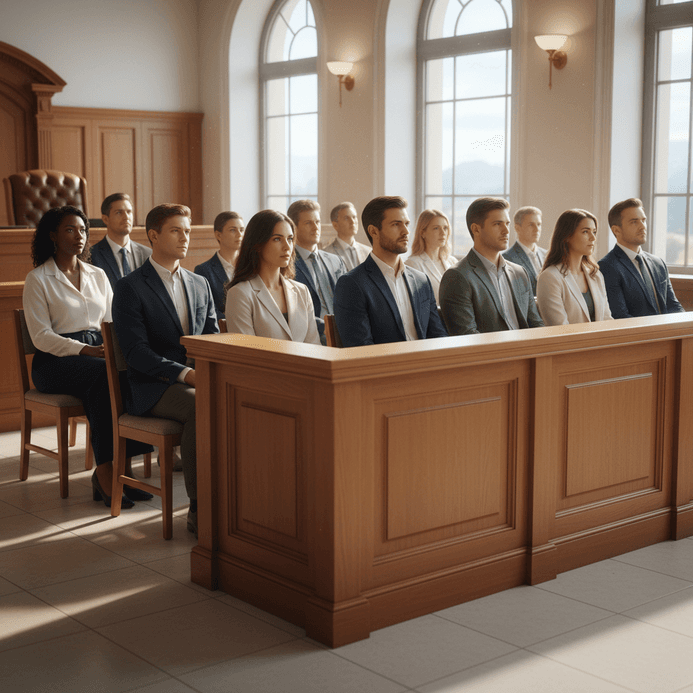
Quick answer: the main types of juries in U.S. courts
In U.S. courts, a petit jury (trial jury) hears evidence in a criminal or civil trial and decides guilt or liability, while a grand jury hears evidence in private and decides whether to return an indictment, which requires finding that a crime was committed and that the person charged committed it. Federal grand juries have 16 to 23 members and need at least 12 votes to indict, while federal petit juries have 6 to 12 members in civil cases and usually 12 in criminal cases. This page covers U.S. federal rules and notes that state practice differs, and some state and local jurisdictions also use civil grand juries.
What a petit jury decides in a trial
A petit jury decides the disputed facts at trial: guilt or innocence in a criminal case, and liability and any damages in a civil case. The jury decides the disputed facts from the admitted evidence. The jury decides only from admitted evidence.
Before the trial starts, prospective jurors are questioned during voir dire, the screening step in which the lawyers and the judge look for bias. The seated jury hears the case, deliberates in private, and returns its verdict.
How many members are on a federal petit jury?
A federal civil petit jury has 6 to 12 members, and a federal criminal petit jury usually has 12. In civil cases, the jury must begin with at least 6 and no more than 12 members, and each juror must take part in the verdict unless excused (Fed. R. Civ. P. 48). Rule 23(b) of the criminal rules permits a jury of fewer than 12 only by the parties' stipulation or when a juror is excused for good cause after trial begins (Fed. R. Crim. P. 23).
A civil verdict must be unanimous unless the parties stipulate otherwise, and it must come from at least 6 jurors. After a verdict, a party may ask the court to poll the jurors individually, and the court may do so on its own. State rules on jury size and verdicts differ, so confirm them in the relevant jurisdiction.
What a grand jury does before trial
A federal grand jury decides whether to return an indictment charging a federal felony. It hears evidence and witness testimony, usually presented by prosecutors, and must determine whether a crime was committed and whether the person charged committed it (U.S. Attorney's Office, Western District of Virginia). It does not return a verdict, and its work comes before any trial.
A federal grand jury has 16 to 23 members, and at least 16 must be present for it to act. If fewer are present, its proceedings must stop. An indictment needs at least 12 jurors voting in favor. The foreperson files the record of the vote with the clerk, who keeps it secret unless the court orders disclosure. Federal grand juries generally serve for 18 months from empanelment, though the court can end service earlier or extend it by six months. In some smaller districts, the grand jury sits for at most one to five consecutive days each month.
Federal grand jury proceedings are kept secret under a general rule of nondisclosure in Fed. R. Crim. P. 6. The advisory notes exempt grand jury deliberations and any juror's vote from the disclosures otherwise allowed.
What a civil grand jury is
A civil grand jury is a separate body that exists only in some state and local jurisdictions, and its powers come from the statute or local rule that creates it. Federal indictments come from the federal grand jury described above, not from a civil grand jury.
Petit jury vs grand jury: how the differences line up
The two jury types differ on purpose, timing, size, and the vote or verdict required.
| Petit jury (trial jury) | Grand jury (federal) | |
|---|---|---|
| Purpose | Decides guilt in a criminal trial, or liability in a civil trial | Decides whether to return an indictment |
| Stage | During trial | Before trial, during the investigation |
| Who presents evidence | Lawyers for each side | Prosecutors, through evidence and witness testimony |
| Decision | Verdict based on trial evidence | Whether a crime was committed and whether the person charged committed it |
| Federal size | Civil: 6 to 12 members. Criminal: usually 12 | 16 to 23 members |
| Vote or verdict | Civil: unanimous unless the parties stipulate otherwise. Criminal: see the criminal verdict rule | At least 12 jurors voting to indict |
| Deliberations | Private | Secret |
Citizens can be called for either type of service. Whether one person can serve on both depends on the court and its rules.
How federal and state courts set jury types
Federal courts follow the federal rules, and state courts set their own rules for jury size, verdicts and service, so the figures in this article describe federal courts only. Federal courts use grand juries to return felony indictments and petit juries in both civil and criminal trials. The current federal rules are listed by the U.S. Courts. For how federal and state law divide responsibilities, see federal law structure. Which court's rules apply depends on jurisdiction, so check the rules published by the court where a case or service would take place.
Serving as a juror: selection and time commitment
Jury service is an obligation of every citizen, and a court first checks whether a person is qualified to serve. Under 28 U.S.C. § 1865, a person is not qualified for grand or petit jury service if they cannot read, write and understand English well enough to complete the juror qualification form, if a mental or physical infirmity prevents satisfactory service, or if a charge for a crime punishable by more than one year in prison is pending or they were convicted of one and their civil rights have not been restored.
After qualification, courts select jurors from eligible citizens, and lawyers may question prospective petit jurors during voir dire before a jury is seated. A district court's juror pamphlet describes the practical steps for jurors in one federal district. For the duties each role carries, see jury roles and duties. Time commitment varies by court and case, so check the court's published terms for a specific service period.
Frequently asked questions about jury types
Are there different types of jury duty?
Yes. In U.S. courts the main types are petit (trial) juries and grand juries, and some state and local jurisdictions also use civil grand juries.
What is the difference between a petit jury and a grand jury?
A petit jury hears trial evidence and decides guilt or liability, while a grand jury decides whether to return an indictment before trial.
How many members are on a federal grand jury?
A federal grand jury has 16 to 23 members, and at least 12 jurors must vote in favor to return an indictment.
How many members are on a federal petit jury?
A civil petit jury has 6 to 12 members under Fed. R. Civ. P. 48(a). A criminal petit jury usually has 12 members unless the parties agree otherwise under Fed. R. Crim. P. 23(b).
Do grand juries decide guilt or innocence?
No. A grand jury decides whether to return an indictment, not whether a person is guilty.
Do civil grand juries exist in every state?
No. Civil grand juries exist only in some state and local jurisdictions, under those jurisdictions' own laws.
Can someone serve on both a grand jury and a petit jury?
Citizens may be called for either type of service. Whether one person can serve on both depends on the court and its rules.
Do jury verdicts have to be unanimous?
In federal civil trials the verdict must be unanimous unless the parties stipulate otherwise. For federal criminal trials, see Fed. R. Crim. P. 31. State rules vary.
Where to find expert witnesses for a jury trial
Legal Experts AI is a marketplace where attorneys and litigation teams find and retain expert witnesses for trials. To start, use Get Matched, or browse expert profiles to review professionals directly.


