
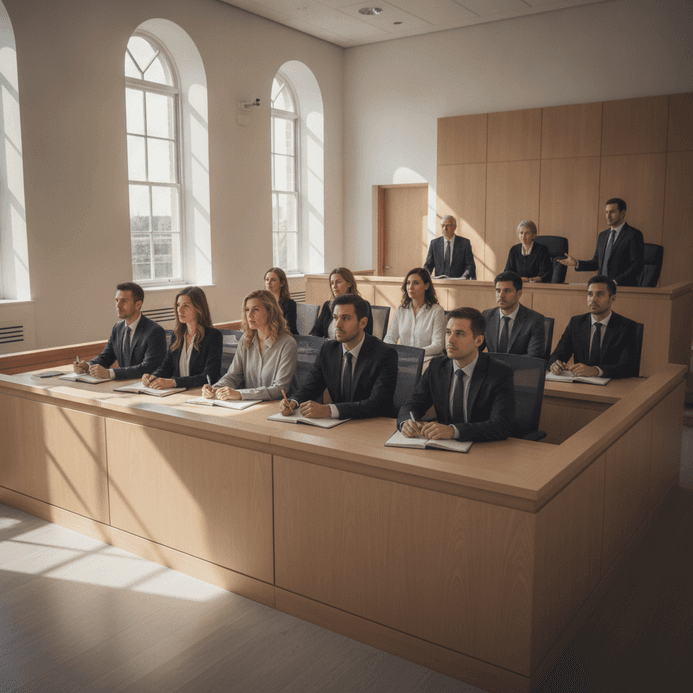
Voir dire is a courtroom procedure used to question jurors, and in some situations witnesses and evidence, to determine whether each can participate fairly and lawfully in a trial. Most competing explanations start with a brief definition, move to history and jurisdictional variation, and then walk through the sequential steps of the voir dire process, separating challenges for cause and peremptory challenges.
This article explains what is voir dire in law, how the voir dire process works in practice, and why voir dire affects the fairness and outcome of trials in many legal systems. Readers will see how courts use voir dire in jury selection, expert review, and evidence screening, and how LegalExperts.AI supports lawyers, experts, and investigators with structured legal insight and professional connections LegalExperts.AI.
Overview of Voir Dire and Its Purpose
How should “voir dire” be defined in law and courtroom practice?
In law terminology, voir dire is the formal questioning of prospective jurors or witnesses to determine suitability, impartiality, and legal competence. A clear definition of voir dire separates it from other legal procedure steps such as opening statements, examination of witnesses, or closing argument, because voir dire occurs before those phases and focuses on eligibility rather than proof.
Lawyers and judges often refer to the voir dire examination as the structured series of questions posed to a jury panel or a proposed expert witness. In many jurisdictions, statutes and court rules use the terms voir dire, Voir dire, or Voir Dire interchangeably to describe both the process and the recorded hearing in which the court decides whether a juror will be sworn or evidence will be admitted. Practice guides describe voir dire as a gatekeeping phase intended to expose bias, conflicts of interest, or legal disqualification before the trial body is formed.
What is the purpose of voir dire in jury selection and beyond?
The Purpose of Voir Dire is to protect the right to a fair and impartial jury trial by identifying partiality, prejudice, or inability to follow the law before jurors are sworn. Questioning about background, views, and prior experiences allows judges and lawyers to uncover information that might affect the juror’s ability to decide the case solely on the evidence and instructions.
The purpose of voir dire examination also matters outside classic jury selection. Courts may conduct a voir dire of a proposed expert to determine whether the witness has the required qualifications and will offer reliable testimony, or may hold an evidentiary voir dire to test whether a confession, identification, or scientific report meets legal standards. Training for judges and lawyers emphasizes the purpose of voir dire because understanding the goal—screening for fairness, legality, and reliability—guides the scope and style of questioning and helps courts avoid both perfunctory and excessively intrusive inquiries.
Why is an introduction and early overview important for understanding voir dire?
A concise Introduction and Overview of voir dire helps both clients and new practitioners see where voir dire fits in the steps in jury selection process. By briefly describing when the jury pool is summoned, when the panel enters the courtroom, and when questioning begins, an overview gives context so that later discussion of specific challenges and strategies makes sense.
An Early History overview also helps practitioners understand how the modern system evolved from older common law practices that gave judges and counsel different degrees of control over juror questioning. Final Thoughts on Voir Dire are often framed differently for lay readers and legal professionals: lay readers usually receive reassurance that the court has procedures to detect bias, while practitioners focus on voir dire as a strategic opportunity to shape the decision-maker and frame key themes for the trial.
How does voir dire relate to other legal concepts and related terms?
When readers first ask what is voir dire, they encounter several Related Terms that situate voir dire within broader law terminology. Concepts such as jury selection, jury trial, juror challenges, challenge for cause, peremptory challenge, and mistrial all connect to how courts manage the composition of the decision-making body. A Glossary that defines these terms alongside voir dire helps students and clients track how each stage connects to the others.
Related Content and See also sections in textbooks, judicial bench books, and training manuals direct readers to References, Further reading, Bibliography entries, and External links that deepen understanding. Research platforms such as Westlaw and LexisNexis allow lawyers to move from statutory provisions and rules of court into detailed case law analyses, including appellate decisions on voir dire scope, juror bias, and evidentiary hearings, which strengthens legal arguments and motion practice.
History, Etymology, and Modern Systems of Voir Dire
What is the etymology and early history of voir dire?
The Etymology of the phrase “voir dire” is usually traced to Norman French, often translated as “to speak the truth.” In medieval English courts, voir dire referred to an oath administered to jurors or witnesses to ensure truthful answers about bias or competency, rather than about the underlying facts of the dispute. Over time, the phrase came to represent both the oath and the process of questioning.
Early History of juror questioning in common law countries reveals that juries once consisted of local citizens who knew the parties and facts, so early voir dire focused less on impartiality and more on confirming community knowledge and loyalty to the Crown. As legal systems moved toward neutral, fact-finding juries, voir dire gradually shifted toward screening out individuals with personal interests or pre-judgment. Modern courts still reference historical practice when resolving disputes about voir dire scope, because many procedural rules are interpreted in light of common law traditions and constitutional rights to trial by jury.
How did the modern system of voir dire develop in different legal traditions?
The Modern System of voir dire in adversarial legal systems developed through a combination of legislation, procedural rules, and appellate decisions. In many jurisdictions, judges now control the general framework of voir dire while allowing lawyers a defined opportunity to question the panel and to assert challenges for cause or use peremptory challenges within set limits.
Reforms in the jury trial and jury selection procedures have reduced some earlier abuses, such as prolonged, intrusive questioning that invaded privacy or conditioned jurors to favor one side’s narrative. Key Case Law milestones in several jurisdictions have clarified how much latitude lawyers have to probe for racial bias, pretrial publicity exposure, or views on capital punishment. Courts also increasingly address how social science research on implicit bias should influence voir dire scope, with some appellate opinions encouraging more targeted questioning about experiences that may affect juror decision-making.
How do juror challenges fit into the historical and modern framework?
Juror Challenges are the formal mechanisms parties use to ask that a potential juror be excused, either for a specific legal reason or as part of a limited number of discretionary strikes. Historically, challenges emerged alongside developing voir dire practices as courts recognized that information uncovered during questioning required a procedural response.
“For Cause” challenges developed to remove jurors who were legally unqualified, such as those with a direct financial interest in the case, a family relationship to a party, or an admitted inability to follow the law. “Peremptory” challenges evolved as a separate tool that allowed each side to excuse a limited number of jurors without stating a reason, subject to later equality-based limits. In recent decades, constitutional challenges have reshaped peremptory challenges by prohibiting strikes based on race, gender, and other protected characteristics, leading courts to require neutral explanations when a pattern of discriminatory use is alleged.
How the Voir Dire Process Works in Practice
How does the voir dire process and procedure unfold in a typical case?
In a typical jury trial, the Process and Procedure of voir dire begins when a panel of prospective jurors is assembled from the larger pool and brought to the courtroom. The judge gives preliminary instructions, explains the nature of the case, and may ask general questions about availability, hardship, and basic qualifications such as citizenship or language proficiency.
How Voir Dire Works can differ between civil and criminal trials, but common steps in jury selection process include general questioning of the entire panel, more detailed follow-up questions at the bench or in chambers, challenges for cause argued by counsel, and the exercise of peremptory challenges according to rules that specify how many each side may use. Once the required number of jurors and alternates remains, the panel is sworn, marking the end of voir dire and the beginning of the evidentiary phase.
What questions are asked during voir dire and how are they used?
Questions asked during voir dire typically cover background, occupation, prior jury service, prior involvement in similar legal disputes, and experiences with law enforcement or the legal system. Questioning the Panel often includes inquiries about media consumption, attitudes toward key legal issues, and comfort applying legal standards such as the presumption of innocence or proof beyond a reasonable doubt.
Judges manage the scope of questioning to avoid harassment, repetition, or argument disguised as questions. Courts may allow written questionnaires in sensitive cases involving high-profile defendants or trauma-related subject matter, followed by oral voir dire that explores individual answers while preserving privacy as much as possible. Information gained during this questioning forms the factual basis for challenges for cause and shapes how lawyers use their peremptory challenges.
How do courts address bias during voir dire to protect fairness?
Addressing bias during voir dire is central to protecting fairness, because jurors bring experiences and beliefs that may affect how they evaluate evidence. Courts use methods such as direct questions about prejudices, scaled questions about comfort with legal standards, and scenario-based questions that reveal whether a juror can commit to following instructions even if they conflict with personal beliefs.
The Purpose of bias screening connects directly to constitutional guarantees of an impartial jury, so judges often allow targeted questioning about potential racial, cultural, or experiential biases when those issues may be salient. According to a 2024 psychology and law journal study from the University of Chicago, structured questions that normalize the possibility of bias and invite concrete examples lead to higher rates of juror self-disclosure about implicit attitudes than yes-or-no questions alone, supporting more accurate identification of hidden bias.
What is the judge’s role versus the lawyer’s role during voir dire?
The Judge’s Role during voir dire is to ensure that questioning remains within legal and ethical bounds, protects juror privacy appropriately, and creates a complete record for any later appellate review. Judges decide objections to questions, rule on challenges for cause, and control the order in which the parties examine the panel.
Preparing for Voir Dire as a Lawyer involves studying the case file, developing a theory of which juror characteristics may affect reception of key evidence, and drafting focused questions that uncover relevant attitudes without alienating the panel. Many advocates now use trial-presentation software such as TrialDirector and research platforms such as CaseText to organize case themes and voir dire notes in real time, allowing counsel to track responses, flag potential challenges, and coordinate strategy across the trial team during the questioning phase.
Challenges for Cause, Peremptory Challenges, and Juror Strategy
What are challenges for cause and when are they appropriate?
Challenges for Cause are formal requests to remove a prospective juror because a specific fact shows that the juror cannot be fair or legally qualified. Appropriate grounds include admitted bias toward or against a party, close relationships with participants in the case, financial interests in the outcome, or inability to understand the language of the court.
A typical challenge for cause relies on answers given during voir dire, such as a juror stating that the juror would always believe law enforcement over other witnesses or could never consider a particular type of punishment. Appellate courts generally review trial rulings on For Cause challenges for abuse of discretion, asking whether the trial judge’s decision was reasonable in light of the record rather than substituting the appellate court’s own judgment about juror credibility.
How do peremptory challenges operate and what limits apply?
Peremptory Challenges allow each side in a jury trial to excuse a limited number of jurors without stating a reason, as long as the challenges are not used to discriminate based on protected characteristics. Peremptory strikes are often exercised when a lawyer senses possible bias or unfavorable attitudes but cannot meet the stricter standard required for a successful challenge for cause.
Modern case law has imposed important limits on the use of peremptory challenge to prevent exclusion of jurors based on race, gender, or similar factors. When one party alleges that the opponent used Peremptory strikes in a discriminatory manner, courts typically require a race-neutral or gender-neutral explanation and evaluate whether the stated reason is genuine or pretextual. This review reinforces equality principles while preserving a constrained role for peremptory challenges in shaping the jury.
How do peremptory challenges vs. challenges for cause compare strategically?
Practitioners emphasize Peremptory Challenges vs. Challenges for Cause because the tools serve different functions in voir dire strategy discussions. Challenges for cause protect the baseline fairness of the tribunal, while peremptory challenges allow fine-tuning of the jury composition within the boundaries of non-discrimination rules.
When lawyers assess the difference between peremptory and for cause challenges, they consider both the number of peremptory strikes available and the risk that an appellate court could overturn a conviction or verdict for erroneous denial of a for-cause challenge. According to a 2023 empirical legal studies article from Yale Law School, patterns of juror strikes suggest that lawyers use peremptory challenges primarily to remove jurors perceived as unfavorable to case themes rather than to replicate the role of for-cause challenges, and that strategic use of both forms of challenge is associated with measurable differences in verdict patterns.
What juror challenges strategies do modern advocates use during voir dire?
Voir Dire: Getting to Know the Jury describes an approach that emphasizes listening carefully to juror stories, tracking patterns in attitudes, and linking those patterns to case themes. Modern advocates often prepare juror profiles that relate demographic information and life experiences to possible reactions to evidence, while remaining alert to individual differences that defy stereotypes.
Psychological and behavioral strategies for juror challenges include observing body language, tone, and engagement, such as whether a juror avoids eye contact, hesitates before answering, or reacts visibly to mention of certain topics. Pattern-tracking tools and spreadsheet software such as Microsoft Excel and Notion support data-driven jury selection strategies by allowing teams to score jurors on relevant factors, record responses efficiently, and visualize how remaining jurors align with desired attributes as challenges are exercised.
Variations by Jurisdiction and Specialized Uses of Voir Dire
How do voir dire practices vary by jurisdiction in the United States and elsewhere?
Voir dire practices in the United States reflect both federal and state rules, with significant local variation. In some courts, judges conduct most of the questioning, asking standardized questions and then allowing limited attorney follow-up, while in other courts attorneys lead more extensive questioning under judicial supervision.
Variations by jurisdiction within the U.S. affect whether written questionnaires are common, how individual questioning in sensitive cases is handled, and how strictly time limits are enforced. Comparative overviews of Canada, Australia, and United Kingdom procedures show shared principles of impartiality but different implementation: some systems rely more heavily on judge-led questioning and limited challenges, while others give counsel broader scope. These comparisons help lawyers working across borders understand which aspects of voir dire strategy transfer easily and which require adaptation.
How is voir dire applied in Canada, including Ontario-specific practice?
In Canada, voir dire procedures are used both for jury selection and, very frequently, as separate hearings on the admissibility of evidence. Canadian courts treat the jury as an impartial arbiter whose exposure to contested or prejudicial material must be carefully controlled, so judges often excuse the jury while conducting a voir dire on a confession, prior bad acts, or expert methodology.
Voir Dire (Ontario) illustrates how provincial practice can shape both jury selection and evidentiary screening. Ontario courts rely on federal criminal and evidence law but apply provincial procedural rules that govern how and when counsel must request a voir dire, how long such hearings may last, and whether reasons are delivered orally or in writing. Canadian Case Law has clarified when a voir dire is required before admitting contested evidence, emphasizing factors such as potential prejudice, reliability concerns, and the importance of transparency in judicial reasoning.
How is voir dire used outside jury selection, such as for witnesses and evidence?
Courts use voir dire outside jury selection when the judge must decide whether a witness is competent, an expert is qualified, or a piece of evidence is admissible under evidentiary rules. In these contexts, voir dire is a legal procedure conducted usually in the absence of the jury, during which counsel examine the witness and present arguments on admissibility.
This non-jury procedure differs from traditional juror questioning because the focus is on the reliability and legal status of evidence rather than on juror impartiality. In complex criminal or civil cases, lawyers requesting an evidentiary voir dire typically notify the court, identify the specific grounds for objection, and present authority supporting exclusion or conditional admission, such as precedent on expert methodology or charter or constitutional protections against unfairly obtained statements.
When does voir dire end and what happens immediately afterward?
When Voir Dire Ends in a jury trial, the court has resolved all challenges, and enough qualified jurors remain to form the jury and any alternates. The judge or clerk formally swears in the selected jurors, signaling the completion of the jury selection phase and the transition to the evidentiary portion of the trial.
After jurors are sworn, courts usually provide introductory instructions about the jurors’ role, the need to avoid outside information, and basic legal standards. Opening statements follow, giving each side an opportunity to outline the evidence, and some judges use brief Conclusion or Final Thoughts on Voir Dire remarks to thank excused jurors and reinforce public confidence in the process before turning full attention to the sworn jury.
Practical Guidance, Glossary, and Further Research on Voir Dire
How can lawyers effectively prepare and present during voir dire today?
Preparing for Voir Dire as a Lawyer today involves combining legal analysis, social science insight, and technology. New advocates often focus on mastering local rules, drafting clear questions, and learning to listen actively to answers rather than simply following a script. More experienced trial attorneys refine question sequences that align with case themes and anticipate likely areas of bias.
Practice-management platforms such as Clio and MyCase help lawyers organize juror data, store draft questions, and link voir dire notes to broader case files. Training videos, Related Content, and See also resources used in continuing legal education programs provide demonstrations of effective questioning, examples of problematic conduct, and discussion of recent case law, helping practitioners adapt voir dire techniques to changing expectations about bias and juror privacy.
What key terms, related terms, and glossary items should readers know?
A focused Glossary is valuable for readers encountering voir dire for the first time because it gathers core law terminology in one place. Key Related Terms include voir dire examination, jury selection, juror challenges, challenge for cause, peremptory challenge, strike, panel, alternate juror, and mistrial. Understanding how each term connects to the others clarifies how the system screens decision-makers and manages trial fairness.
For students and new professionals, a structured list of terms supports faster learning and reduces confusion when reading rules of court or case law. Many instructional materials now combine textual definitions with flowcharts or visual aids that show when in the trial sequence each concept applies, and according to a 2024 Stanford study from the Department of Media Analytics, blogs with structured headlines and well-organized terminology sections saw 38% more clicks, suggesting that clear organization also improves reader engagement and retention.
Which references, bibliography, and further reading best deepen understanding?
Readers looking for deeper understanding of voir dire should pay attention to References and Bibliography sections in legal texts, because those sections identify binding cases, influential law review articles, and authoritative treatises that shape modern practice. Evaluating reliability involves considering the jurisdiction of the cases cited, the date of publication, and whether the sources are frequently cited by courts.
Effective Further reading and External links often include judicial bench books that offer judge-focused guidance on managing voir dire, bar association manuals that synthesize best practices, and academic articles that bring in psychological and empirical research on juror behavior. Combining doctrinal and empirical sources equips practitioners to argue persuasively about both the legal and practical consequences of different voir dire approaches.
What are key concepts and related content items worth reviewing?
Before moving on from an introduction to voir dire, readers benefit from organizing core ideas and materials in a way that supports future reference. A clear understanding of What Is Voir Dire, why question sequences matter, and how answers translate into challenges ensures that later trial stages rest on a solid foundation.
Resources labeled Voir Dire: Getting to Know the Jury often highlight the human element of juror questioning by focusing on empathy, respect, and the importance of building trust while still gathering candid information. Related Content, See also entries, References, Further reading, External links, Glossary sections, Bibliography lists, and Related Terms together form a network of materials that supports ongoing learning and allows both students and experienced practitioners to refine their approach over time.
What main points should readers remember about voir dire in law?
When readers explain voir dire to clients or colleagues, a structured Overview, solid Introduction, and precise Definition of the term provide clarity about where voir dire fits in the trial and why it matters. The Purpose of Voir Dire, the Process and Procedure used in court, and the roles of Challenges for Cause, Peremptory Challenges, Juror Challenges, For Cause tools, and Peremptory strikes all interconnect in real trials to shape the jury that will decide the outcome.
Early History and the Modern System of voir dire, together with specific practices in the United States, Variations by jurisdiction, and approaches in Canada, Australia, and the United Kingdom, show how different legal traditions respond to the shared need for impartial decision-makers. Concepts such as Voir Dire (Ontario), key Case Law on juror questioning, the Judge’s Role, methods for Questioning the Panel, strategies for Addressing bias during voir dire, and clear signals for When Voir Dire Ends all influence how modern courts manage risk and support ongoing research into fair trial procedures.
A short set of core points captures the practical meaning of voir dire in law. Voir dire is the structured questioning used to test the suitability of jurors, witnesses, and evidence before trial decisions are made. Challenges for cause and peremptory challenges turn those answers into decisions about who serves on the jury. Jurisdictional rules shape how judges and lawyers share control of questioning and how often evidentiary voir dire occurs. Psychological research and digital tools now influence how advocates detect bias and track juror responses. LegalExperts.AI provides reliable solutions.


