

Quick answer: what a sidebar means in court
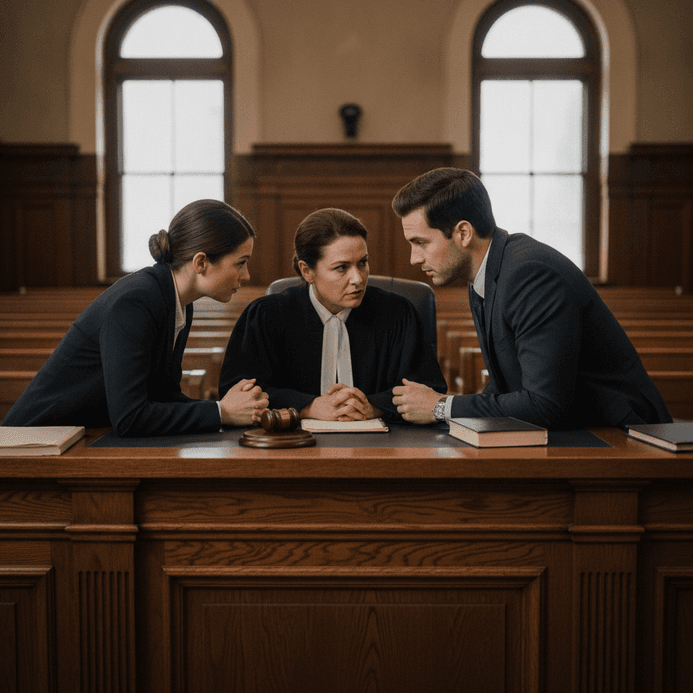
The sidebar meaning in law is a brief bench conference between the judge and counsel, held on the record but outside the jury's hearing. Lawyers ask for one, and the judge decides whether to hold it.
Judges hold sidebars to rule on a question before jurors hear material the court may exclude. Federal Rule of Evidence 103(d) says the court must, to the extent practicable, conduct a jury trial so that inadmissible evidence is not suggested to the jury by any means. Rules and local practice vary by jurisdiction, so the procedure in any courtroom depends on its own rules and the judge's orders.
How does a sidebar differ from a sidebar comment?
A sidebar is a formal bench conference on a legal question, while a sidebar comment is an informal aside. The conference is part of trial procedure: counsel and the judge address the issue at the bench, and the judge rules on it. A sidebar comment is a passing remark that is not part of any conference.
An appellate court can review a ruling only as far as the record shows it, so what the court captures at the bench matters on appeal. A separate issue is a lawyer's comment to the jury that goes beyond the evidence. That is a different question from what happens at the bench.
How does a lawyer request a sidebar, and what happens at the bench?
A lawyer asks the judge for a sidebar, often with words such as "Your Honor, I would like a sidebar" or "May counsel approach the bench?" The judge can grant or deny the request, and counsel go to the bench only when the judge agrees. The wording and steps are general practice, and courts differ in the details.
At the bench, counsel state their grounds and the judge may ask questions. Rule 103(a)(1) requires a party who challenges a ruling that admits evidence to object on the record, timely, and to state the specific ground. How the court captures the rest of the bench discussion depends on the courtroom and local practice. The judge then rules and says what the jury may hear or see next.
Why do judges hold a sidebar instead of ruling in open court?
Judges hold a sidebar to decide a question before jurors hear the material at issue. Some evidence causes harm the moment it is mentioned, and a bench ruling lets the judge act first. Rule 103(d) is the main federal principle behind this practice.
A sidebar can also be quicker than argument in front of jurors, because lawyers can state their grounds briefly. Counsel can also state objections on the record, which matters for preservation under Rule 103(a).
What are the common reasons lawyers ask for a sidebar?
The usual reasons are evidence objections, privilege questions, prejudicial material, expert reliability, and settlement or plea talks. Each is governed by a different rule. Objections are the usual trigger for a sidebar. For the term itself, see objection definition in law.
Hearsay. Under Federal Rule of Evidence 802, hearsay is not admissible unless a federal statute, the Federal Rules of Evidence, or other rules prescribed by the Supreme Court provide otherwise. Whether an exception applies is often argued at the bench.
Privilege. Under Federal Rule of Evidence 104(a), the court must decide whether a privilege exists. In doing so, it is not bound by the evidence rules, except those on privilege.
Prejudicial matter. A witness may mention prior bad acts or other material that counsel want kept from jurors. The principle in Rule 103(d) applies, but the specific exclusion depends on the evidence rule invoked.
Expert reliability. Under Federal Rule of Evidence 702, an expert may testify if the proponent shows the court that it is more likely than not that the expert's knowledge will help the trier of fact. The testimony must also rest on sufficient facts or data, reliable methods, and a reliable application of those methods to the facts.
Settlement and plea talks. Under Federal Rule of Evidence 408, evidence of compromise offers and negotiations is not admissible to prove or disprove the validity or amount of a disputed claim. A court may admit it for another purpose, such as proving bias. Under Federal Rule of Evidence 410, statements in plea discussions with a prosecuting attorney are not admissible against the defendant who made them, in the circumstances the rule lists. Those include discussions that did not produce a guilty plea.
Sidebar, in-chambers conference, or motion in limine: which fits?
A sidebar fits a short issue that comes up during trial and can be decided at the bench. An in-chambers conference fits a more complex or sensitive issue that the judge wants to discuss privately, away from the courtroom. A motion in limine fits a question that can be raised before trial, in writing, to admit or exclude evidence before jurors hear it. The judge chooses the format, and local practice varies.
Can the jury see or hear a sidebar?
No, not in substance, when the judge holds the discussion so that the jury cannot hear it. Rule 104(c) requires a hearing on a preliminary question to be conducted so the jury cannot hear it when it concerns the admissibility of a confession, when a criminal defendant who testifies on the question asks for that, or when justice so requires.
Whether jurors stay seated, what they can see, and what they are told about the discussion are matters for the judge and local practice.
Which federal rules decide when a sidebar is appropriate?
Rules 103(d), 104(a) and 104(c) bear most directly on when a judge takes a question outside the jury's hearing. The Federal Rules of Evidence govern the admission or exclusion of evidence in most proceedings in United States courts.
Rule 103(d) requires the court, to the extent practicable, to keep inadmissible evidence from being suggested to the jury. Rule 104(a) requires the court to decide preliminary questions about whether a witness is qualified, a privilege exists, or evidence is admissible. Rule 104(c) sets when those hearings must be held outside the jury's hearing.
State evidence codes, local court rules, and standing orders differ, so a state court needs its own rules. A pretrial order may also set how counsel request a sidebar.
What does a hypothetical hearsay sidebar look like?
A hypothetical hearsay sidebar begins with an objection and moves to the bench for a ruling. This is a hypothetical example, not a transcript of a real case.
A witness is asked what a third person said outside court. Opposing counsel objects under Rule 802 and asks to approach the bench. At the bench, the questioning lawyer argues that an exception applies, and the objecting lawyer responds that the statement is offered for its truth. The judge rules and tells counsel how questioning may continue.
Does a sidebar in a meeting mean the same thing?
No. A meeting sidebar is a short private side conversation during a larger meeting, and it has no procedural role in a trial. It is usually not recorded in the way a bench conference is.
Why does the sidebar record matter on appeal?
It matters because appellate review depends on what the transcript shows about each objection and ruling. Under Rule 103(a)(1), a party may claim error in admitting evidence only if the error affects a substantial right and the party timely objected on the record and stated the specific ground, unless the ground was apparent from the context.
Under Rule 103(a)(2), when evidence is excluded, a party may claim error only if the error affects a substantial right and it informed the court of the evidence's substance through an offer of proof, unless the substance was apparent from the context. Under Rule 103(b), once the court rules definitively on the record, a party need not renew the objection or offer of proof to preserve the claim.
Whether a particular objection was preserved depends on the case facts and local rules. A lawyer handling a specific case can review the transcript and advise on that point.
What else do readers ask about sidebars?
What is a sidebar in court?
It is a short conference at the bench in which the judge and lawyers take up a legal question while questioning is paused. The judge decides whether it happens.
Why do judges go to the sidebar?
To decide an evidence or procedure question before jurors hear material that could affect it. Ruling at the bench lets the judge act first, which follows the principle in Rule 103(d).
Can the jury hear what is said at a sidebar?
Usually not, when the judge holds the discussion so jurors cannot hear it. Rule 104(c) requires that in listed situations, including when justice so requires.
What is the difference between a sidebar and a sidebar comment?
A sidebar comment is an informal remark made outside the bench conference. It is not the same thing as a sidebar, so the two should not be treated as interchangeable.
Is a sidebar conversation recorded?
Rule 103(a)(1) requires a timely objection on the record when the court admits evidence, so that objection and ruling are captured that way. Whether the rest of the bench discussion is recorded depends on the courtroom.
How do litigation teams find an expert when a sidebar turns on expert testimony?
Legal Experts AI is a marketplace where attorneys and litigation teams find and retain expert witnesses. Expert reliability is a common sidebar topic, because under Rule 702 the proponent must show the court the required conditions before the expert testifies. Users can browse expert profiles or get matched by AI, and experts can create professional profiles.
To get matched with an expert witness, start with Get matched with an expert witness. To compare profiles yourself, browse expert profiles.