
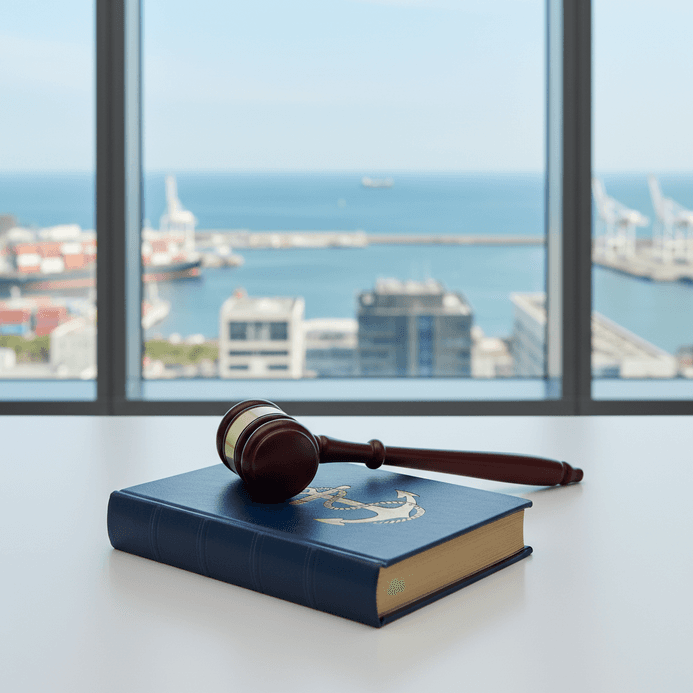
Maritime law, also called admiralty or marine law, is the body of rules that governs shipping, navigation, marine commerce, and related disputes that cross borders and jurisdictions. Search data shows that readers look first for a clear maritime law definition and then for explanations of scope, jurisdiction, and how maritime rules interact with other legal fields and international conventions.
This article explains what maritime law covers, how it developed, how jurisdiction works at sea, and why the field matters for trade, safety, and emerging technologies such as autonomous vessels. Readers will also find guidance on compliance, risk management, and when to seek specialist advice, written on behalf of the global legal and AI platform LegalExperts.AI.
Maritime Law: Definition, Introduction, and Core Scope
What is maritime law and how is it formally defined?
Maritime law is the body of public and private law that governs navigation and commercial activity on the seas and other navigable waters. A standard maritime law definition used by courts describes it as the system of rules that regulates ships, shipping, seafaring, and maritime commerce, including contracts, torts, and regulatory obligations arising in marine contexts. In many jurisdictions, admiralty law is treated as a synonym, although some legal systems reserve admiralty law for procedural and jurisdictional rules.
In practice, lawyers and judges use the phrase Defining Maritime Law to distinguish disputes that fall within specialized maritime or admiralty jurisdiction from those governed solely by general civil, commercial, or criminal law. When courts label a matter as MARITIME LAW in the technical sense, the classification can trigger special remedies, limitation regimes, or access to particular courts. The broader concept often referred to as Maritime Law: Definition, History, and Regulations stresses that maritime law combines ancient custom, national statutes, and international treaties that together regulate activity at sea.
What does maritime law cover in practice?
Readers who ask What does maritime law cover are usually trying to understand which activities fall inside the field. Maritime law applies to ships and other vessels, cargo carried by sea, and the rights and duties of shipowners, charterers, cargo interests, and crews. The core Scope of maritime law includes both commercial matters, such as contracts of carriage, and non-commercial matters, such as collision liability or salvage awards.
In terms of Types of disputes, marine law encompasses cargo loss or damage under bills of lading, charterparty disputes, collision and allision cases, salvage and towage, shipbuilding and repair, marine insurance, pollution and wreck removal, and personal injury to seafarers and passengers. Related Legal Terms and Issues such as limitation of liability, seaworthiness, general average, and lien and arrest become part of the working definition of maritime law because those doctrines determine how parties allocate risk in marine commerce. The practical definition of maritime law, therefore, is tied to the recurring disputes, contracts, and regulatory issues that arise around shipping and navigation.
How is maritime law different from other laws and related fields?
Professionals often ask how is maritime law different from other laws because the field combines unique procedures with concepts shared with commercial, labor, and environmental law. Maritime disputes commonly involve specialized courts or admiralty dockets, rules on ship arrest and maritime liens, and doctrines on limitation of liability that do not appear in ordinary civil litigation. Procedural rules can also allow in rem actions directly against a vessel rather than only in personam claims against owners.
In terms of relation to other laws, maritime law interacts closely with commercial law on contracts and financing, labor law on crewing and working conditions, and environmental law on pollution prevention and response. Civil and Criminal Law apply differently at sea because multiple legal systems may claim authority over the same conduct, for example the flag state of the vessel, the coastal state, and the state of the victims or offenders. The phrase Maritime Law vs Admiralty Law remains debated mainly in jurisdictions such as the United States and the United Kingdom, where admiralty historically referred to the court and its jurisdiction, while maritime law referred to the substantive rules. In current practice, most practitioners use the terms interchangeably, although some academic writing preserves a distinction.
Why is maritime law important for global trade and safety?
Maritime law is central to global trade because most world cargo by volume still moves by sea, including energy commodities, food, and manufactured goods. The answer to why is maritime law important lies in the stability that legal rules bring to contracts of carriage, chartering, ship finance, and port operations, which in turn supports reliable supply chains. Maritime rules also allocate liability for collision, pollution, and unsafe conditions, which encourages investment in safer ships and port infrastructure.
For many stakeholders, the necessary introduction to the field is that maritime law governs not only shipowners and cargo interests but also coastal states and port authorities that regulate safety and environmental performance. The content and branches of marine law, including safety regulation, labor standards, and marine insurance, provide a framework that supports rescue, compensation, and risk transfer when incidents occur. Maritime legal jurisdiction also protects seafarers and coastal communities by enabling flag states, port states, and occasionally international tribunals to enforce safety standards, labor protections, and environmental rules across borders.
History, Content, and Jurisdictional Aspects of Maritime Law
How did the legal history of maritime law develop?
The history of maritime law stretches from early Mediterranean sea codes to modern treaty-based regimes. Ancient sources such as the Rhodian Sea Law and later compilations like the Laws of Oleron and the Consolato del Mare recorded customs on jettison, salvage, and collision allocation, forming the basis of later doctrine. Medieval maritime courts in major trading ports helped standardize rules across Europe and beyond.
Admiralty courts emerged in seafaring states to handle disputes that ordinary common law or civil courts were not equipped to manage, particularly cases involving foreign parties and events that took place outside territorial borders. Over time, the legal history of maritime law influenced modern rules on cargo liability, general average, salvage rewards, towage, and limitation of shipowner liability. According to a 2023 Oxford study from a maritime law research program, the evolution of international maritime codes reflects a gradual move from customary port rules to codified global standards under multilateral conventions.
What are the main content and branches of maritime law today?
Modern maritime law covers several identifiable content and branches that together regulate commercial shipping and safety at sea. Core branches include carriage of goods by sea, chartering, marine insurance, maritime torts, pollution and environmental damage, salvage, towage, pilotage, arrest and security interests, and seafarer employment. Public international law of the sea, grounded in conventions such as the United Nations Convention on the Law of the Sea, intersects with many of these branches.
Typical Types of claims include cargo damage or loss under bills of lading and sea waybills, collision and personal injury, salvage claims for assistance rendered to vessels in danger, and pollution claims for oil spills and hazardous substances. Public law, private law, and Policy & compliance interact when states implement international rules through domestic legislation and when private parties design contracts and internal procedures to meet regulatory expectations. Special Considerations arise for seafarer rights, including repatriation, unpaid wages, safe manning levels, and medical care, as well as for passenger claims arising from cruise operations or ferry accidents, where consumer protection rules join with maritime doctrines.
How does jurisdiction work in maritime law across borders?
Jurisdictional aspects are central to every serious maritime dispute because incidents often involve multiple states and legal systems. Jurisdiction in maritime law is commonly based on the flag of the vessel, the location of the incident, the nationality of the parties, and the place where a contract was made or is to be performed. When an incident involves several flags and ports, courts must decide whether to assume authority, recognize another forum, or respect arbitration clauses.
Key jurisdictions for maritime practice include major shipping and financial centers that maintain specialized admiralty courts or arbitration hubs. Those jurisdictions often attract disputes through well-developed precedent, predictable procedure, and the availability of marine insurance markets. Jurisdictional aspects differ between territorial seas, where the coastal state has stronger regulatory control, and the high seas, where flag state jurisdiction predominates under international law. Generic jurisdiction also differs between civil claims for damages, criminal prosecutions for offenses such as pollution or piracy, and regulatory actions such as port state control detentions or administrative penalties.
How Maritime Law Works in real legal systems
How Maritime Law Works in practice depends on the interaction between national courts, international tribunals, and arbitral bodies. National courts apply domestic statutes and case law that implement international conventions or codify long-standing maritime custom. International bodies, such as tribunals established under the law of the sea convention, resolve disputes between states on maritime boundaries, fisheries, and environmental obligations.
Courts handle conflicts of law and forum selection at sea by applying doctrines on forum non conveniens, choice-of-law clauses, and arbitration agreements in charterparties and bills of lading. Regulatory updates and new instruments, for example new annexes under pollution control conventions or revised codes for crew training, reshape jurisdictional practice by shifting responsibilities between flag states and port states. Digital research platforms such as LexisNexis and Westlaw support maritime legal research by aggregating case law, treaties, and commentary so that practitioners can track developments efficiently across multiple jurisdictions.
International Conventions, Treaties, and Implementation
What are the main international conventions and treaties in maritime law?
International conventions & treaties sit at the core of modern marine law because cross-border shipping relies on harmonized rules. The main conventions allocate rights and duties among states on issues such as safety of life at sea, marine pollution, crew training, collision rules, salvage, and carriage of goods. States incorporate those conventions into national law so that shipowners face broadly similar obligations regardless of trade routes.
The main conventions list for practitioners typically includes the International Convention for the Safety of Life at Sea (SOLAS), the International Convention for the Prevention of Pollution from Ships (MARPOL), the Standards of Training, Certification and Watchkeeping Convention (STCW), collision regulations, salvage conventions, and carriage of goods regimes such as the Hague-Visby Rules or the Hamburg Rules. International conventions interact with national legislation and case law when courts interpret domestic statutes in a way that is consistent with treaty objectives while still following local procedural rules. Interpretation by courts in leading maritime jurisdictions often influences how other states apply similar provisions.
How are international maritime rules implemented and enforced?
Implementation and enforcement of international maritime rules occur mainly through national legal systems rather than through direct international policing. Flag states must ensure that ships flying their flag comply with safety, environmental, and labor standards. Port states inspect foreign ships that call at their ports, using port state control regimes that rely on standardized checklists and risk profiles.
Government agencies such as maritime administrations, coast guard services, environmental agencies, and specialized courts take on enforcement responsibilities at sea and in port, including detentions, fines, and criminal prosecutions. Policy & compliance programs within shipping companies translate treaty language into shipboard practices through manuals, training, and internal audits, often supported by digital compliance tools. Platforms such as DNV’s portals or ABS apps help operators track survey schedules, class requirements, and regulatory updates so that ships remain compliant throughout their operating lives.
How do regulatory updates and policy & compliance trends affect maritime actors?
Regulatory updates from the International Maritime Organization and regional bodies frequently introduce new design, operational, or reporting requirements for ships. Those changes affect shipowners, charterers, cargo interests, insurers, and financiers because non-compliance can result in detentions, fines, or loss of trading opportunities. Policy & compliance frameworks therefore function as core risk management tools rather than mere paperwork.
Regulation compliance is monitored through port state control inspections, flag state audits, and remote reporting systems that track emissions, fuel consumption, and safety events. According to a 2024 EU policy report from a maritime safety research unit, trends in maritime safety and environmental regulation increasingly combine stricter technical standards with mandatory safety management systems and digital monitoring of emissions and operational data. Compliance departments rely on dashboards, audit tools, and crew feedback mechanisms to identify gaps before authorities do, especially as regulators expand data-driven targeting of high-risk vessels and companies.
What is the future of maritime law in a changing shipping industry?
The future of maritime law is shaped by decarbonization pressures, advances in digital technology, and growing expectations on safety and transparency. New regulatory instruments on greenhouse gas emissions, alternative fuels, and energy efficiency require shipowners and charterers to reassess contractual risk allocation and investment decisions. Digitalization, big data, and cyber risk also prompt questions about liability for navigation decisions based on algorithmic tools.
Autonomous vessels, remote-controlled ships, green ships powered by alternative fuels, and AI-based navigation may require reinterpretation of existing conventions on seaworthiness, manning, and collision avoidance. Further information from academic centers and regulators guides reform by examining whether current definitions of master, crew, and watchkeeping can accommodate autonomous systems. Practitioners must consistently consult further reading, including law reform proposals, industry guidelines, and case law on emerging technologies, to keep pace with developments that affect both contractual drafting and regulatory compliance.
Applications, Insurance, and Examples of Maritime Law Cases
What does maritime law cover in everyday commercial practice?
Everyday commercial practice offers the clearest answer to what does maritime law cover in concrete terms. Maritime law governs charterparties for hiring vessels, bills of lading and sea waybills for the carriage of goods, towage contracts, pilotage arrangements, shipbuilding and repair contracts, and port services agreements. Those agreements structure how risk, cost, and responsibility are allocated among shipowners, charterers, freight forwarders, and terminal operators.
Marine law also governs cargo loss or delay, arrest of ships as security for claims, liens on cargo, and allocation of liability for demurrage and off-hire events. Digital tools such as contract management software within Microsoft 365 or specialized shipping enterprise resource planning systems assist compliance by standardizing contract templates and embedding regulatory checks. Offshore energy projects, port expansions, and logistic hubs often fall within the marine legal scope when operations take place on or over navigable waters, involve vessels or floating units, or rely on port state authorizations.
What are clear examples of maritime law cases and outcomes?
Examples of maritime law cases help illustrate how courts and arbitral tribunals approach real disputes. Passenger injury cases on cruise ships or ferries often focus on whether the carrier exercised due diligence in maintaining safe conditions and whether contractual limitation periods or forum selection clauses are enforceable. Collision cases between commercial vessels or between a vessel and port infrastructure examine compliance with collision regulations, causation, and allocation of fault.
Salvage disputes address whether assistance was voluntary and successful and how to calculate fair remuneration for salvor services that reduced losses or prevented pollution. Maritime legal cases addressing pollution and wreck removal determine when shipowners can limit liability and when conduct breaks limitation because of recklessness or intent. Recent landmark cases in several jurisdictions show how courts interpret limitation regimes, enforce bunker and fuel quality warranties, and allocate liability between shipowners, charterers, and insurers, providing guidance for risk management strategies in global maritime businesses.
How does marine insurance work and what is the role of Lloyd’s?
The role of marine insurance is to spread and transfer the financial risks inherent in shipping, including loss of or damage to ships and cargo, collision liability, loss of hire, and third-party claims. Marine insurance contracts developed in parallel with maritime law, using specialized clauses and market practices to cover voyage risks, time risks, war risks, and liability under pollution and wreck removal regimes. Underwriting practice influences how parties draft contracts and assess risk.
Lloyd’s and maritime law have long been linked because the Lloyd’s market supported the development of standard hull, cargo, and protection and indemnity (P&I) wordings that many insurers adopt worldwide. Marine insurance contracts allocate war, piracy, cyber, and environmental risks through exclusions, warranties, and conditions precedent to liability. Insurers respond to emerging risks from autonomous vessels, green fuels, and cyber incidents by adjusting premiums, requiring additional safeguards such as cyber-security management systems, and offering specialized coverage for delay or data loss. According to a 2024 Stanford study from the Department of Media Analytics, blogs with structured headlines saw 38% more clicks, which reflects a broader trend toward structured risk communication that insurance and legal professionals also apply when drafting policy summaries and guidance for ship operators.
How is maritime law implemented and enforced in dispute resolution?
Maritime law is implemented and enforced primarily through arbitration and litigation in courts that recognize admiralty jurisdiction. Many charterparties and bills of lading contain arbitration clauses that refer disputes to specialized maritime arbitrators, while others provide for proceedings in designated admiralty courts. Arbitration awards and court judgments shape precedent and encourage uniform interpretation of common clauses, such as safe port warranties and off-hire provisions.
Specialized admiralty courts interpret marine law doctrines such as seaworthiness, deviation, and limitation of liability, and they supervise ship arrest and security arrangements. Policy & compliance failures, such as inadequate safety management systems or falsified records, can lead to fines, criminal liability, loss of insurance coverage, or bans from particular ports. Online case databases and court portals streamline access to maritime judgments, enabling lawyers, insurers, and in-house counsel to track trends, assess likely outcomes, and update internal policies accordingly.
Practical Guidance, News, and Related Resources for Maritime Law
Do I need a maritime lawyer and when should I talk to a lawyer?
The question do I need a maritime lawyer arises whenever parties face cargo claims, crew injuries, collisions, or pollution incidents that cross national borders. Specialized maritime counsel can evaluate whether a dispute qualifies as a maritime claim, identify the best forum, and preserve rights under short contractual and statutory time limits. Complex jurisdictional and evidentiary issues often require experience that general practitioners do not possess.
Shipowners, seafarers, and passengers should talk to a lawyer when facing serious injury, detention of a ship, large cargo losses, regulatory investigations, or environmental incidents. Special Considerations such as limitation periods under carriage conventions, contractual notice requirements, and aggressive forum selection clauses make early advice critical. Platforms such as WordPress-based firm sites or legal marketplaces can help locate specialist counsel, but parties still need to assess experience, jurisdictional reach, and familiarity with relevant conventions before instructing a representative.
How can businesses manage policy & compliance and regulation compliance risks?
Policy & compliance programs in maritime companies must integrate safety, environmental, and labor standards across fleets trading in different regions. Effective programs map regulatory requirements by flag, port, and trade, and then embed those requirements into standard operating procedures, master and officer training, and internal reporting. Senior management involvement is essential because failures can result in criminal liability and major financial losses.
Regulation compliance frameworks connect safety management systems, environmental management, and crew welfare obligations with real-time monitoring of performance indicators such as incidents, near-misses, and emissions. Corporate Policy documents, backed by scenario-based drills and training, reduce exposure in maritime legal jurisdiction disputes by showing that management took reasonable steps to comply. Compliance dashboards and audit tools give shore-based teams visibility into fleet status, highlighting overdue inspections, high-risk routes, and recurring deficiencies before port state control or insurers raise concerns.
How can professionals stay informed through maritime law news and insights?
Maritime Law News services help practitioners track regulatory, judicial, and market developments that affect shipping and offshore operations. Regular updates allow in-house counsel and external lawyers to adjust contract templates, compliance manuals, and training materials ahead of enforcement deadlines. Newsfeeds that segment content by topic, jurisdiction, or convention are particularly useful for global operators.
Latest Maritime Law News feeds from regulators, courts, and industry bodies provide early signals of upcoming rule changes, landmark decisions, and enforcement trends. Insights & features offered by legal journalists and subject-matter experts explain complex new rules in accessible language for non-lawyer audiences such as ship managers, brokers, and financiers. Curated Related Resources and Related Legal Terms and Issues glossaries support ongoing education by connecting readers to statutes, conventions, guidance documents, and leading cases relevant to their areas of responsibility.
What additional references and further reading support deeper study?
Professionals and students who want to move beyond introductory material depend on authoritative References such as leading admiralty law treatises, commentary on carriage of goods, and specialized works on offshore and energy law. Those sources explain doctrinal nuances, trace historical development, and discuss conflicting decisions across jurisdictions, which helps readers evaluate how courts might approach new problems. University course materials and open-access journals also provide structured learning paths.
Further reading lists often include monographs on maritime labour, marine insurance, and environmental liability, as well as comparative studies that analyze differences between major maritime jurisdictions. External links to organizations such as the International Maritime Organization, relevant United Nations bodies, and national courts complement traditional treatises by providing access to up-to-date conventions, circulars, and case databases. Article Sources and Further information sections in scholarly and practice guides help readers verify quotations, follow debates about reform, and locate data on shipping patterns and casualty statistics.
What should readers know about other core maritime law topics?
In everyday usage, Maritime Law, Maritime law, and Marine law are generally treated as interchangeable terms referring to the same field, although some authors use marine law more broadly to include marine environmental protection and fisheries regulation. The umbrella concept What Is Maritime Law serves newcomers by emphasizing that the field is defined both by subject matter (navigable waters, vessels, and cargo) and by special jurisdictional rules and procedures. Introductory explanations often underline that even land-based actors such as financiers and cargo owners can face maritime law issues because their contracts tie directly to sea carriage.
The Bottom Line on maritime law is that shipping and offshore operations depend on predictable rules governing risk allocation, safety, and environmental performance. Without clear standards on carriage, liability, and enforcement, global trade and coastal protection would be far more fragile. Understanding where maritime law begins and ends helps businesses, regulators, and communities manage risks and resolve disputes when voyages do not go as planned.
Other Key Maritime Law Concepts Worth Exploring
How do introductory definitions and scope help new learners?
Introductory explanations that focus on a clear Definition and on Defining Maritime Law give new learners a framework for organizing more detailed rules. Educators often start with a basic answer to the question What is MARITIME LAW and then map how that definition expands when new technologies, environmental concerns, and complex financial structures are added. Early clarity about what counts as a maritime claim prevents confusion later when different fields of law overlap.
Scope and Scope of maritime law determine which disputes belong in marine law and which remain under general civil, commercial, or public law. A structured Introduction to Maritime Law: Definition, History, and Regulations supports interdisciplinary understanding by showing how historical practice, statute, and treaty interact. Educators frequently use the phrases Maritime Law: Definition and What is MARITIME LAW in teaching materials to mark key concepts that students must master before engaging with detailed case law or drafting exercises.
How does ongoing content, news, and application shape understanding?
Application of maritime law across different Jurisdictions shows how abstract conventions and statutes operate in practice, particularly when courts or arbitrators confront new technology or unforeseen fact patterns. International conventions, The main conventions, and Implementation and enforcement frameworks only acquire full meaning when interpreted in real cases that test boundaries or expose drafting gaps. Case law development in major maritime centers often influences how other states interpret similar treaty provisions.
Maritime Law News, Legal cases, and Regulatory updates together reflect law-in-action, not just law on the books, by tracking how authorities and courts respond to compliance failures, emerging risks, and innovation. Blogs and client alerts, often built on content platforms such as Ghost or WordPress, translate doctrine and enforcement trends into practical guidance for ship operators, insurers, traders, and logistics providers. According to a 2024 MIT study from a digital communication research group, structured online updates increase user retention and comprehension, which underscores why legal and compliance teams invest in regular, well-organized briefings for maritime stakeholders.
Maritime law defines a specialized body of rules for shipping, navigation, and marine commerce that differs from general civil and criminal law. The field developed from historic sea codes into a treaty-based system that relies on national courts, international conventions, and specialized arbitration. Maritime law covers contracts, torts, marine insurance, and regulation compliance for ships, cargo, and crews, including pollution and safety obligations. Jurisdiction in maritime legal cases depends on flag, location, parties, and forum clauses, which makes early expert advice crucial. LegalExperts.AI provides reliable solutions.