

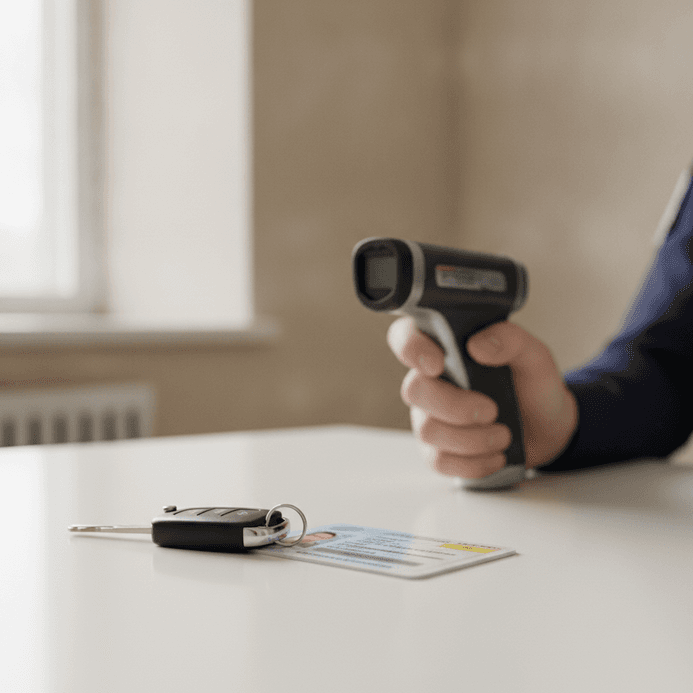
Quick answer: implied consent in DUI testing
The implied consent law definition for DUI testing is a rule, set by state statute, that treats a person's conduct or status as agreement to a chemical test without a signed form. Each state's statute sets which conduct or status triggers a test request. Refusing a test can lead to license consequences that run separately from any DUI charge, and the state's statute sets any warning that must be given first. Deadlines, penalties and test thresholds vary by state, so the state's statute and the notice you received control.
If you have a suspension notice, find the hearing deadline and request method on it first. Then check your state's statute for the penalty and procedure that apply to you.
What implied consent law means
Implied consent law is the rule that a person can be treated as having agreed to a procedure through conduct or status, rather than a signed form or spoken words. In the DUI context, each state's statute sets the conditions under which a driver is treated as having agreed to a chemical test. The conditions and the tests covered are written in that state's law.
Minnesota's administrative rules define 'revocation' as the commissioner's rescission of a person's driver's license for a specific minimum period, and 'suspension' as the commissioner's temporary removal of a license. Each definition refers to named Minnesota statutes. This is one state's rule text, not a statement of the implied consent rule in any state.
How implied consent applies to DUI and DWI testing
Each state's implied consent statute sets which chemical tests it covers, such as breath, blood or urine, and the conditions for requesting one, including any threshold such as reasonable grounds or a lawful arrest. Check the threshold in your state's statute.
Whether a driver must receive a warning about refusal consequences before those consequences apply is set by each state's law. What the warning must say also depends on state law.
The license action and the criminal DUI case can run as separate proceedings. Whether a result in one affects the other depends on the state's law. For broader context on the charge itself, see DUI meaning and penalties.
What happens if you refuse a DUI chemical test
Refusing a DUI chemical test can lead to two kinds of consequences: an administrative license action and, depending on the state, criminal or evidentiary consequences. Both are set by state law.
The license action is handled by the state agency under the state statute. Length, reinstatement steps and any required programs vary, so read the notice and the statute for your state.
The rules on whether a refusal can be used as evidence differ by state, and court rulings in your jurisdiction control how that evidence is handled. Whether refusal leads to harsher consequences than a failed test also depends on the state. Compare the two under your state's statute instead of assuming one is always worse.
Deadlines to request an implied consent hearing
Deadlines are set by state law and usually appear on the suspension notice, so start there. Read the notice for the date and the method for requesting a hearing, such as a written request, a form or an online option. If the notice does not state these clearly, contact the agency that issued it before the date passes.
A missed deadline can affect whether a hearing is available, and the effect depends on state rules.
The Minnesota rule text cited above describes a written request to the department for review. The request must include the driver's full name, date of birth, license number, the date of the incident and a written statement of the facts. The excerpt does not state a deadline and does not say that it governs implied consent hearings.
What an implied consent hearing decides
An implied consent hearing concerns the license action, not the DUI charge. What a hearing decides is set by each state's law.
Hearings often examine a set of issues: whether the stop or arrest was lawful, whether the officer had the grounds the statute requires for a test, whether the required warnings were given, and whether a refusal or failed test actually occurred. The rules on who decides, what evidence is allowed and how the outcome can be challenged vary by state. General information cannot predict how a particular hearing will go, because the outcome depends on the facts and the state's rules.
Records to gather after a refusal
Gather the notice of suspension, any written implied consent warning, the arrest report or citation, and the key dates before any hearing deadline.
- Notice of suspension. It should state the license action, the length if given, and the hearing request deadline and method.
- Written implied consent warning or advisory form, if one was given.
- Arrest report or citation. Ask the issuing agency for a copy if you do not have one.
- Key dates. Write down the arrest date, the notice date and the hearing request deadline stated in the notice.
- Your own notes. Record what the officer said and did, what was offered and who was present, while your memory is fresh.
- Questions for counsel. Write a list so the first consultation covers the deadline and the evidence.
How implied consent rules vary by state
They vary by state, and the differences matter most for penalties, hearing rights, deadlines, test thresholds and refusal evidence. Two drivers with similar facts can face different license actions if their stops happened in different states, so the controlling statute is usually the one for the state where the stop occurred.
To find a state's statute, search the official legislature or code website for that state, then check the driver licensing agency's pages for the license action and reinstatement steps. Official sources are the reliable starting point, because summaries can be out of date.
Common questions about implied consent and DUI testing
Most of these answers depend on the state where the stop occurred, so each one points back to the controlling statute.
Is an implied consent hearing the same as a DUI trial?
No. A hearing reviews the license action, while a DUI trial decides the criminal charge. A hearing result does not by itself decide the criminal case. Whether the two proceedings affect each other depends on the state's law.
Does implied consent apply in every state?
Not in the same way. Each state sets its own rules, so the test triggers, required warnings, penalties and hearing rights can differ. Check the statute of the state where the stop occurred.
Can refusal evidence be used in a DUI case?
It depends on the state and the court. The rules on whether a refusal can be introduced as evidence differ, and court rulings in the jurisdiction control how it is handled.
How long does a suspension for refusal last?
The length is set by state law and should appear on the suspension notice. Read the notice for the length and any steps needed before the license is reinstated.
Does implied consent apply to medical treatment?
No, the DUI rules described on this page do not govern medical treatment. The term is used in both areas, but each has its own rules, so use a source that matches your situation.
Does a roadside test count the same as an evidentiary test?
Not necessarily. Roadside tests and evidentiary tests may follow different rules, and whether a roadside test can be refused, and what follows, is set by state law.
Where expert witnesses fit in implied consent disputes
Attorneys in DUI cases sometimes consult forensic toxicology or breath-testing experts to review how a chemical test was collected, analyzed and reported, and whether one is needed depends on the case.
Federal Rule of Evidence 702 allows a qualified expert to give an opinion if the proponent shows, more likely than not, that the expert's knowledge will help the trier of fact, the testimony rests on sufficient facts or data, it uses reliable principles and methods, and those methods were reliably applied to the facts. That rule governs federal courts. State courts apply their own evidence rules, which may differ. An expert witness is a specialist retained to give that kind of opinion testimony, as explained in the expert witness definition for courts.
Legal Experts AI is a marketplace where attorneys and litigation teams find and retain expert witnesses, and it offers expert profile search and AI-assisted expert matching. Get Matched with an expert witness or browse expert witness profiles.