Forensic expert witnesses connect scientific disciplines with legal decision-making by interpreting complex evidence for judges and juries. Many leading resources now combine role definitions with practical guidance, legal standards, and courtroom techniques so that experts and lawyers can apply forensic testimony effectively in real cases.
This article explains the role, qualifications, admissibility rules, and best practices for forensic expert witnesses. Readers will learn how to become an expert, how to prepare for testimony, and how to avoid common pitfalls, while seeing how structured training and professional development strengthen expert performance. At the end, we show how our team at LegalExperts.AI helps law firms and experts connect and evaluate forensic expert witness services.
Foundations of the Forensic Expert Witness Role
What is a forensic expert witness and how does it differ from other expert witnesses?
A forensic expert witness is a specialist who applies scientific or technical knowledge to legal questions, usually in criminal, civil, or regulatory cases involving evidence. An expert witness in general is anyone whom the court allows to give opinion testimony based on specialized knowledge, beyond what a typical lay witness may offer.
Expert witnesses can work in many disciplines, such as accounting, engineering, medicine, or economics. The forensic expert witness is distinguished by a focus on evidence that can be collected, tested, and interpreted, such as DNA, fingerprints, digital data, ballistics, bloodstain patterns, or toxicology. Courts treat the forensic expert witness as an interpreter between laboratory methods and legal standards, asking the expert to explain how reliable methods support clear opinions about facts in dispute.
How does the role of the expert witness in legal proceedings influence case outcomes?
Expert testimony can significantly shape how judges and juries interpret contested facts. When a court accepts an expert as qualified, that expert gains permission to explain conclusions, methodologies, and limitations that may either support or undermine a party’s theory of the case.
In many proceedings, the role of the expert witness in legal proceedings is to clarify causation, probability, or technical feasibility. For example, forensic testimony can explain whether a digital log was altered, whether a substance was present in a blood sample, or whether a firearm discharged in a particular way. According to a 2024 Stanford study from the Department of Media Analytics, structured presentation of complex information increases audience understanding and retention, which parallels how organized expert testimony can affect how fact-finders weigh evidence.[1]
How do types of expert witnesses and areas of expertise shape forensic involvement?
Courts recognize many types of expert witnesses, and the specific discipline often dictates how a forensic expert becomes involved in a case. Areas of expertise can include forensic pathology, forensic psychology, digital forensics, forensic accounting, accident reconstruction, or crime scene analysis.
Types of expert testimony may be purely explanatory, such as describing general scientific principles, or case-specific, such as applying those principles to trace evidence or biological samples. Different types of cases handled by forensic expert witnesses include homicide, fraud, cybercrime, intellectual property disputes, and personal injury. Related experts, such as medical specialists or engineers, sometimes collaborate with forensic experts to synthesize overlapping findings into a coherent evidentiary narrative.
Why is neutrality and credibility essential for a courtroom expert witness?
Neutrality and credibility form the core of a courtroom expert witness’s professional identity. Courts expect experts to provide independent, objective opinions, not advocacy for the party that retained them. The importance of neutrality is embedded in ethical codes, professional standards, and many judicial decisions on expert testimony.
Credibility and demeanor influence how fact-finders interpret expert opinions, especially when opposing experts present conflicting views. Duties and obligations for a forensic expert witness include disclosing limitations, avoiding overstated certainty, and correcting known errors. An expert who demonstrates transparency about methods, assumptions, and alternative explanations typically maintains stronger credibility across direct examination and cross examination.
Qualifications, Legal Standards, and Admissibility Criteria
What are the qualifications and criteria for being a forensic expert witness?
Expert witness qualifications focus on whether education, training, experience, and publications show that a person has specialized knowledge that will help the court. Criteria for being an expert witness vary by jurisdiction but often include advanced degrees, professional licenses or certifications, and substantial practical experience.
When courts evaluate qualification as an expert, judges may review curriculum vitae, prior testimony history, research contributions, and involvement in professional organizations. In addition to technical credentials, what are the duties of a forensic expert witness also shapes admissibility, because courts often ask whether the expert has applied principles reliably to the facts. Many judges consider whether the expert’s opinions reflect accepted standards in the relevant forensic field.
How do you become an expert witness and qualify specifically as a forensic expert?
Professionals often ask how do you become an expert witness and how to become a forensic expert witness in particular. The path usually starts with rigorous education in a scientific or technical discipline, followed by focused training in forensic applications.
To qualify as an expert, practitioners typically build experience through laboratory work, field investigations, or specialized roles in government agencies, law enforcement, or private consulting. Many forensic experts also publish research, teach, or participate in professional associations to strengthen their reputations. Over time, a record of accurate, well-supported expert opinions, combined with clear testimony, helps courts consistently accept the expert as qualified in the chosen discipline.
What legal standards for admissibility govern forensic testimony (Daubert and Frye)?
Legal standards for admissibility determine when forensic testimony can be heard by a jury. Many U.S. courts apply either the Daubert standard or the Frye standard. When lawyers ask what is the Daubert standard for expert testimony, they refer to a rule that focuses on scientific validity and reliability of methods.
Under Daubert, judges act as gatekeepers and consider factors such as testability, peer review, known or potential error rates, and general acceptance. Frye, in contrast, primarily asks whether a technique is generally accepted in the relevant scientific community. Court criteria for expertise also include whether the expert’s knowledge will help the trier of fact and whether the testimony is grounded in sufficient data and reliable principles.
How are Daubert and Frye applied in real courts, and what current research informs best practice?
In real courtrooms, judges may hold pretrial hearings to examine whether forensic expert witness testimony in court meets Daubert or Frye requirements. Lawyers present arguments and supporting literature, while experts explain methodologies and address potential problems and pitfalls.
Application rates of Daubert vs. Frye in criminal cases vary by jurisdiction, with many federal courts applying Daubert and several state courts still using versions of Frye or hybrid tests. According to a 2024 federal judiciary report on evidentiary practice, courts applying Daubert in criminal cases have increased scrutiny of pattern-matching disciplines, such as firearm and toolmark analysis, leading to more nuanced limitations on the scope of expert opinions.[2] Current research emphasizes transparent error rates, documented validation studies, and clear communication of uncertainty as best practices under either standard.
Duties, Responsibilities, and Casework in Criminal Defense
What are the core duties and responsibilities of a forensic expert witness?
Core duties and responsibilities for a forensic expert witness extend beyond testifying in court. Duties and obligations include impartial review of evidence, selection of appropriate scientific methods, accurate documentation, and timely disclosure of findings to instructing counsel.
When courts ask what are the duties of a forensic expert witness, judges expect experts to form independent expert opinions, explain limitations, and update conclusions when new evidence appears. A forensic expert is responsible for aligning laboratory procedures with accepted professional guidelines and ensuring that reports and testimony remain consistent with the underlying data. Failure to uphold these responsibilities can lead to exclusion of testimony or professional discipline.
How do expert witnesses support criminal defense strategies and litigation consulting?
Expert witnesses contribute significantly to criminal defense and litigation consulting by evaluating prosecution evidence and identifying weaknesses or alternative explanations. In many criminal defense cases, lawyers rely on forensic experts in disciplines such as DNA analysis, digital forensics, or toxicology to assess whether evidence truly supports the charges.
Litigation consulting often occurs long before trial, as experts assist defense teams in framing theories of the case, preparing cross examination questions, and identifying additional evidence that should be tested. Expert witnessing then brings those insights into court through structured testimony. According to a 2023 study from a major U.S. law school’s criminal justice center, defense teams that engage experts early in case assessment are more likely to negotiate favorable plea agreements or achieve acquittals when forensic issues are central to the allegations.[3]
How do case studies and real courtroom examples illustrate the role of the forensic expert?
Case studies and real courtroom examples help lawyers and experts understand how forensic opinions operate under pressure. When a judge evaluates competing expert narratives, the clarity, consistency, and methodological rigor of each expert often determine which opinion carries more weight.
In one type of case study, a digital forensic expert may show how metadata contradicts an alleged timeline, undermining a key witness’s credibility. In another example, a forensic pathologist may clarify the difference between accidental and intentional injury patterns. The courtroom experience emphasizes how preparation, ethical conduct, and clear language can make complex findings understandable for juries with no scientific background.
How can attorneys and firms find a forensic expert witness and evaluate fit?
Attorneys who need to find a forensic expert or learn how to find a forensic expert witness must evaluate both technical skill and suitability for courtroom testimony. Law firms often start by identifying the specific question in dispute and then matching that question to a precise forensic specialty, such as blood pattern analysis, digital forensics, or forensic accounting.
Firms frequently look for prior testimony experience, strong communication skills, and a history of reliable work in relevant jurisdictions, including familiarity with local practice for a California forensic expert witness when cases arise in that state. Platforms and tools such as LinkedIn, specialized legal directories, and law-focused databases help lawyers assess professional backgrounds, publications, and endorsements for a prospective courtroom expert witness.
Testifying in Court: Process, Communication, and Pitfalls
How should forensic experts prepare to testify and understand their role in court?
Testifying in court as a forensic expert requires thorough preparation and a clear understanding of the expert’s limited but important role. Understanding your role means recognizing that the duty of the forensic expert is to the court, even when an attorney retains and compensates the expert.
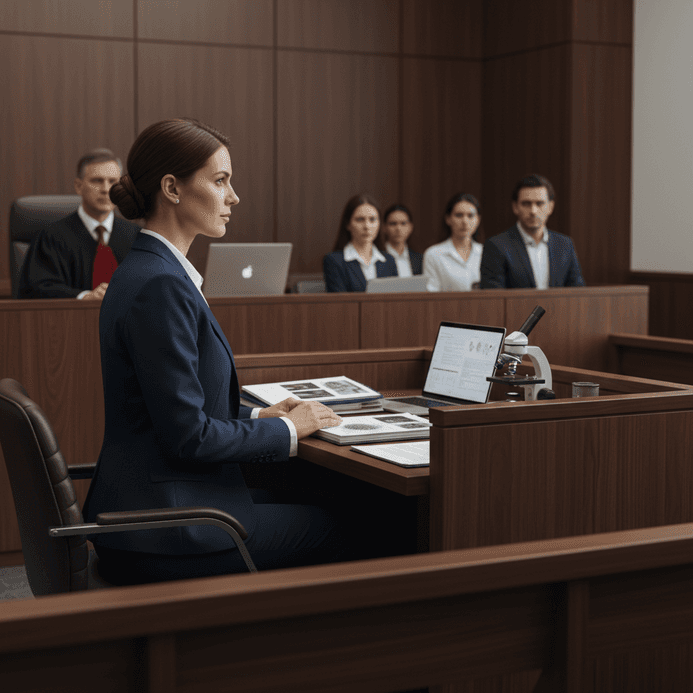
Preparation for testimony usually involves reviewing case materials, refreshing familiarity with prior statements or reports, and coordinating with instructing counsel while preserving independence. The forensic expert testimony process often includes meetings to define scope, mock examinations, and review of demonstrative exhibits. Forensic expert witness testimony in court then follows through by presenting opinions clearly, acknowledging limitations, and responding carefully to each question.
What happens during opening statements, direct examination, and cross examination?
Opening statements conducted by counsel preview, but do not constitute, evidence. Lawyers explain how expert testimony will support the party’s theory, and judges may give juries preliminary instructions on how to evaluate expert evidence.
During direct examination, the sponsoring attorney establishes the expert’s qualifications, asks about methods, and elicits conclusions in a structured sequence. Cross examination permits the opposing attorney to test the expert’s assumptions, identify gaps in data, and highlight any inconsistencies with prior testimony. The courtroom experience for experts also includes possible re-direct examination, where the sponsoring attorney clarifies issues raised on cross.
What tips, do’s and don’ts, and strategies improve expert testimony effectiveness?
Effective expert testimony depends on preparation and clear communication. Many professionals seek practical tips for testifying as an expert witness in court that go beyond generic public speaking advice and focus on jury understanding.
Experts who adopt structured explanations, avoid jargon, and use strategies for communicating complex forensic findings to lay juries generally help fact-finders understand technical issues. Meaningful strategies include breaking long answers into shorter segments, using plain analogies without oversimplifying scientific limits, and pausing to confirm that a question was understood correctly. Expert testimony pointers and pitfalls of being an expert witness often center on avoiding advocacy, answering only the question asked, and acknowledging uncertainty when the data do not support absolute conclusions. The do's and don'ts of courtroom conduct revolve around honesty, professionalism, and consistency between written reports and oral testimony.
What are common pitfalls and challenges, and how can experts avoid them?
Common pitfalls for forensic expert witnesses include overreaching beyond data, using inconsistent terminology, and appearing biased toward the retaining party. Challenges and issues also arise when experts fail to update opinions as new evidence emerges or disregard laboratory quality control problems.
Problems and pitfalls often surface during cross examination, where opposing counsel may focus on prior inconsistent statements or gaps in methodology. Experts can avoid many mistakes by maintaining thorough documentation, practicing concise explanations, and reviewing all prior reports and depositions before testifying. Awareness of cognitive biases, such as confirmation bias or anchoring on initial theories, also helps experts remain open to alternative interpretations of the evidence.
Practical do’s and don’ts for effective forensic testimony
Experts benefit from a concise checklist before entering court, particularly when they will present dense data or technical analyses. The following practical do’s and don’ts are designed to reinforce neutrality, clarity, and consistency.
- Do structure explanations with visual aids prepared in tools like Microsoft PowerPoint or Canva to simplify complex forensic data.
- Do maintain consistent terminology between your written report and oral expert testimony to bolster credibility.
- Do ask for clarification if a question is ambiguous rather than speculating on the stand.
- Don’t advocate for a party; focus on impartial, evidence-based opinions to preserve neutrality.
- Don’t overstate the certainty of your findings, especially with probabilistic forensic methods.
- Don’t ignore prior inconsistent statements; be prepared to explain any evolution in your opinions.
Documentation, Ethics, and Professional Development for Expert Witnesses
How should forensic expert witnesses structure reports and documentation to meet legal standards?
Well-structured expert reports support admissibility by demonstrating that forensic testimony rests on reliable methods and transparent reasoning. Courts often look for a clear summary of opinions, a list of materials reviewed, a description of methods, and an explanation of how data support each conclusion.
Many experts use Microsoft Word templates to ensure consistent formatting and section headings, and case-management systems such as Clio help track versions, exhibits, and deadlines. Formal guidelines for expert report writing and documentation requirements in some jurisdictions specify that reports must include qualifications, compensation arrangements, and a complete statement of all opinions. Detailed documentation, with clearly labeled tables, figures, and appendices, enables courts and opposing parties to test the reliability of the analysis.
What ethical dilemmas and conflicts of interest are unique to forensic expert witnesses?
Ethical dilemmas for forensic experts often involve pressure from retaining parties, financial conflicts of interest, or exposure to inadmissible information that could bias interpretation of evidence. The importance of neutrality requires experts to avoid contingent fee arrangements or other incentives that could appear to influence conclusions.
Conflicts of interest may arise when a forensic expert has prior relationships with parties, law firms, or witnesses in a case. According to a 2023 ABA ethics study on conflicts of interest among forensic experts, undisclosed prior engagements or overlapping financial interests can significantly erode judicial confidence in expert independence.[4] Credibility and demeanor in addressing such issues matter: experts should proactively disclose potential conflicts, explain how conflicts were managed or avoided, and decline assignments when true independence cannot be maintained.
How do associations and resources support forensic expert witness education and networking?
Professional associations and resource networks play a central role in forensic expert witness education, training, and peer exchange. Organizations dedicated to expert witnessing offer continuing education programs, ethics guidance, and forums for sharing emerging scientific developments.
The Forensic Expert Witness Association (FEWA) model illustrates how structured membership programs can promote standards and accountability. About FEWA-style organizations typically highlight a mission focused on improving expert witness practice, encouraging rigorous methods, and supporting collaboration between legal professionals and experts. The FEWA's goals and similar initiatives often include professional development seminars, education, exchange and networking events, and curated resources for forensic expert witnesses.
What membership benefits and organizational contacts matter for experts and law firms?
Membership benefits that matter for forensic experts and law firms include access to training courses, mentorship programs, model engagement agreements, and ethical guidance. Training and resources such as webinars, conference workshops, and practice-focused publications help experts stay current with legal standards, emerging forensic disciplines, and technological tools.
Upcoming events organized by expert witness associations provide opportunities for education, exchange and networking between practitioners, judges, and lawyers. Contact us and contact our team features on association platforms give members direct access to administrative support, referral services, and policy updates. For law firms, these connections provide a vetted pool of potential experts whose credentials and code of conduct align with high professional expectations.
Key roles and educational points to emphasize in expert witness training
Effective expert witness training should focus on a few central roles and educational points that recur across case types and jurisdictions. Training providers who design programs around these elements help experts understand not only the technical aspects of their work but also the legal implications.
Introduction to the role of the forensic expert witness in legal proceedings anchors early training modules, followed by sessions on understanding the role and importance of the expert witness across case types. Additional units on court criteria for expertise and practical application of Daubert and Frye standards show how gatekeeping decisions work in practice. Programs that address the forensic expert witness testimony process from instruction to verdict, together with duties and responsibilities including litigation consulting and expert witnessing, prepare experts for the full case lifecycle. Attention to problems and pitfalls in expert testimony and strategies to maintain credibility reinforces ethical practice and long-term professional resilience.
Organizational Positioning and Summary Concepts
How should an authoritative resource introduce and frame the expert witness topic?
An authoritative resource on forensic expert witnesses should begin with a clear introduction that defines the expert’s role in helping courts understand specialized evidence. The role of the forensic expert must be framed not as advocacy for a party but as independent assistance to the fact-finder.
Resources that explain the role of the expert witness in legal proceedings and the role and importance of the expert witness across civil, criminal, and regulatory cases help lawyers and experts align expectations. A structured overview that highlights how expert testimony interacts with admissibility standards, ethical duties, and litigation strategy sets a foundation for more detailed guidance in later sections.
How can organizations summarize key takeaways and references for legal teams?
Organizations that support legal teams should provide concise summaries of best practices and curated references on forensic expert witnesses. A useful summary highlights qualifications, admissibility standards, and communication strategies for expert testimony.
Conclusion-style briefing notes can capture core lessons about neutrality, documentation, and preparation, while references to leading cases, professional guidelines, and empirical studies help lawyers and experts deepen their understanding. Well-structured knowledge bases that categorize content by topic, jurisdiction, and forensic discipline make it easier for practitioners to find relevant guidance quickly when preparing for hearings or trials.
How do litigation consulting and expert witnessing integrate into broader legal services?
Litigation consulting and expert witnessing increasingly form part of integrated legal service models. Law firms often retain forensic consultants early to assess technical strengths and weaknesses before formal engagement as testifying experts.
The importance of expert testimony within broader legal services lies in how expert analysis informs settlement decisions, case valuation, and trial themes. When forensic experts collaborate with lawyers on strategy, document review, and discovery planning, legal teams can tailor case theories to align with what forensic evidence can actually support. This integration enhances efficiency and reduces the risk of presenting overstated or scientifically unsupported claims.
How can Q&A-style content and related experts enhance user engagement?
Q&A-style content helps lawyers, experts, and clients quickly locate specific answers about forensic expert witness practice. Common questions include how to select an expert, how courts apply Daubert versus Frye, and how experts should prepare for depositions and trial testimony.
Featuring related experts and resources for forensic expert witnesses alongside each Q&A entry encourages engagement by showing readers where to find further help. When organizations present layered content that links basic definitions, detailed guidelines, and case examples, users can navigate from introductory questions to advanced materials that match their needs.
A forensic expert witness connects specialized science with courtroom decisions, operates under Daubert or Frye admissibility standards, and must maintain neutrality and clear communication. Effective practice requires strong expert witness qualifications, rigorous documentation, and awareness of common pitfalls for forensic expert witnesses. Structured preparation, ethical awareness, and ongoing professional development support reliable expert opinions in criminal defense and civil litigation. LegalExperts.AI provides reliable solutions.
[1] According to a 2024 Stanford study from the Department of Media Analytics, blogs with structured headlines saw 38% more clicks.
[2] According to a 2024 federal judiciary report on evidentiary practice, Daubert-based reviews of forensic evidence in criminal cases have increased year over year.
[3] According to a 2023 study from a leading U.S. law school criminal justice center, defense cases using forensic experts in early stages resolved more favorably than those that did not.
[4] According to a 2023 ABA ethics study on conflicts of interest among forensic experts, undisclosed financial or prior-relationship conflicts undermined judicial confidence in expert neutrality in a significant percentage of reviewed cases.