

Quick answer
This page explains bench law in plain terms and separates three terms that are often confused: bench, bar and bench trial.
In law, bench means the judiciary: the judges who hear cases and decide them as a court. The word also names the raised desk or platform where judges sit in a courtroom. In a bench trial, the judge decides the case instead of a jury.
What does bench mean in law?
Bench means the judiciary, the judges acting as a court. A lawyer who argues "before the bench" is making the argument to the judge, not to a jury. The term is used across court systems, although each system organizes its courts differently.
When does bench refer to the judiciary?
Bench refers to the judiciary when it names judges acting in their judicial role, such as ruling on a motion, managing a hearing or entering an order. Judges issue rulings that bind the parties and manage the proceedings, so in this sense "the bench" means the office, not the furniture. How courts are structured depends on the legal system, and the jurisdiction section below covers the main differences.
When does bench refer to the courtroom seat?
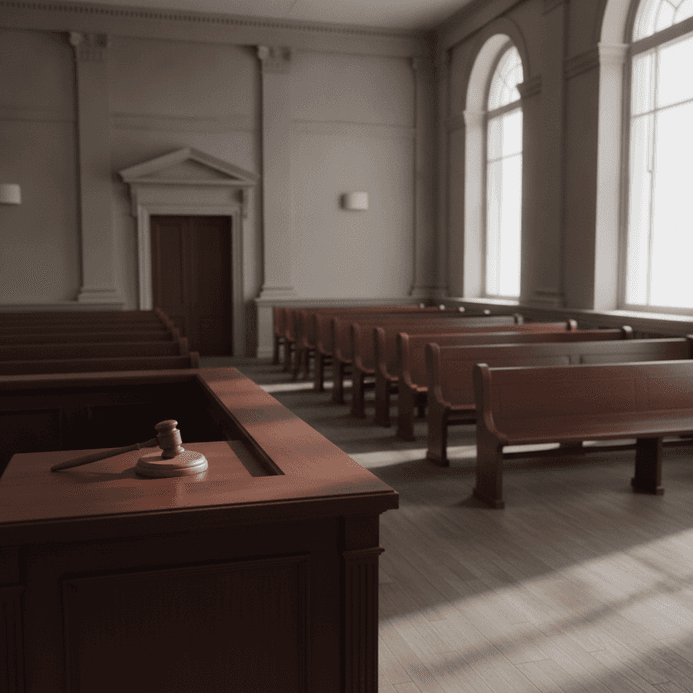
It refers to the courtroom seat when it names the raised desk or platform where the judge sits. Many people read the raised position as a sign of the judge's authority, though that is a description of the setting rather than a legal rule. Courtrooms are laid out differently, so the height and shape of the bench vary from one building to another.
What is a bench trial, and how does it differ from a jury trial?
A bench trial is a trial without a jury, in which the judge hears the evidence and decides the case. A jury trial gives the decision on the facts to a group of jurors, while the judge manages the trial. The table compares the two.
| Point | Bench trial | Jury trial |
|---|---|---|
| Who decides the facts | The judge | The jury |
| Who handles legal questions | The judge | The judge |
| How the trial type is set | The parties agree, or the rules allow it | Used where a jury was demanded and not waived |
When can a jury trial be waived?
Yes, in some federal civil cases: when the parties agree to a nonjury trial, or when the court finds, on motion or on its own, that there is no federal right to a jury trial on an issue.. Under Fed. R. Civ. P. 39(a), a trial on a demanded jury issue "must be by jury unless" the parties file a stipulation to a nonjury trial, or the court finds that "there is no federal right to a jury trial" on those issues.
Criminal cases follow a separate set of rules. The Federal Rules of Criminal Procedure govern criminal proceedings in federal district courts, the courts of appeals and the Supreme Court. Jury waiver in criminal cases is also governed by those rules, so check the current text of the criminal rule on waiver at the official source before relying on any waiver condition.
How do bar and bench differ?
The bench is the judges who decide cases, and the bar is the lawyers admitted to practice who represent parties. "Bench and bar" is a common phrase that names the judiciary and the legal profession together. The roles stay separate in the courtroom: the judge decides the case, and the lawyer presents the party's position.
How is bench used in courtroom practice?
Lawyers and judges use bench in phrases such as bench conference, ruling from the bench and before the bench. A bench conference is a short discussion between the lawyers and the judge at the bench, and courts set their own rules for when these happen. An oral ruling "from the bench" is a decision the judge announces in court. Arguing "before the bench" means presenting a case to the judge.
Do bench trial rules vary by jurisdiction?
Yes, in part. Federal courts apply federal rules, and the Federal Rules of Civil Procedure govern civil proceedings in the United States district courts. State courts follow their own statutes, court rules and local rules, so the controlling rule for a state bench trial comes from that state. Appellate courts also sit as benches. Confirm which rule applies to your court before relying on it.
Which related legal terms should you read next?
Readers who want the next step can start with the related entries below. The order meaning in law guide explains judicial orders issued from the bench. The common law and civil law differences guide covers how court structures differ between legal systems. The expert witness definition entry explains the expert testimony a judge weighs in a bench trial.
How do expert witnesses fit when a judge is the fact-finder?
In a bench trial, the judge is the one who weighs expert testimony when deciding the facts. Legal Experts AI is a marketplace where attorneys and litigation teams find and retain expert witnesses. Users can browse expert profiles or get matched by AI-assisted matching. You can Get Matched with expert witnesses for AI-assisted matching, or browse expert witness profiles to compare candidates yourself.


