


Introduction
Global commerce, technology, and evolving regulation have transformed the expert witness industry. As international business expanded, cross-border disputes multiplied, and litigation extended into new sectors such as data privacy and internet governance. Meanwhile, technology created entirely new categories of legal issues, from cryptocurrency fraud to AI liability.
Together, these shifts have given rise to a broader ecosystem where law, science, business, and innovation intersect, pushing experts into increasingly collaborative and cross-disciplinary roles.
The role itself is not new. Expert witnesses, as leaders of different industries converging to share their unique insights, have been essential to legal practice. Courts have long relied on expert witnesses to make sense of nuanced evidence, translating technical findings into legally relevant insights to support judicial decision-making. What has changed is the scope and sophistication of that role.
Sector Growth
The expert witness industry has expanded its scope and experienced steady ascension, particularly in the United States, the largest litigation market in the world. According to a recent 360iResearch market overview, the Expert Witness Services Market was valued at approximately USD 665.43 million in 2025 and is projected to reach USD 705.68 million in 2026, reflecting a compound annual growth rate (CAGR) of 5.79%. By 2032, the market is expected to approach USD 987.32 million. That upward trajectory has a clear story behind it. Litigation across virtually every sector has grown more technical and more consequential, requiring expert voices that can translate specialized knowledge into credible courtroom testimony. Where complexity rises, so does demand for expertise.
Environmental and ESG litigation illustrates this well. As corporations face mounting scrutiny over sustainability practices and regulatory compliance, litigation now requires experts who can assess ecological impact, quantify damages, and situate findings within environmental science, governance, and legal frameworks. This demand for environmental expert witness services is substantial, leading to the emergence of this distinct and rapidly growing market segment, expanding at a compound annual growth rate (CAGR) of 8.22%.
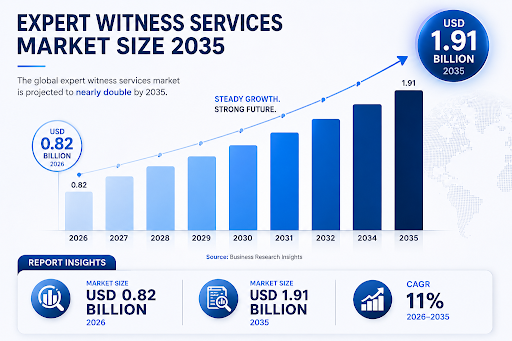
Source: Business Research Insights
Technological evolution is accelerating this growth further. Traditionally established areas of law, such as intellectual property and defamation, now carry a distinctly internet-based character that demands entirely new forms of expertise.
In intellectual property disputes, for example, the internet and artificial intelligence have reshaped how infringement is created, distributed, and measured. Market confusion now spreads faster when counterfeit products can reach global audiences overnight. Brand dilution has also accelerated in instances where unauthorized use proliferates across online channels. In a digital market, infringement becomes harder to track and quantify when it occurs simultaneously across borders. Such cases have increased reliance on specialists in internet presence, digital consumer perception, and infringement impact.
Unique Intersection & Cross-Industry Leaders
The next phase of the industry's development is emerging at the intersection of legal demand and specialized knowledge across industries. That is where the uniqueness and demand for expert witness work lies: in connecting the normative, rule-based legal methodologies and the world of specialized knowledge, integrating the best of diverse fields.

Source: Magnific
With litigation becoming increasingly complex, no single field fully captures the details of a dispute that spans multiple domains, requiring collaboration among experts with different perspectives. Specialists identify patterns and implications that might otherwise be overlooked, forming networks that enrich the case-building process. This characteristic of expert witness work is consistent with evidentiary theory, which has long recognized that multifaceted facts require interpretation through multiple lenses. The difference today lies in the scale and sophistication of that collaboration.
In high-stakes litigation, witness selection, coordination, and deployment as a team are as important as individual qualifications. The O.J. Simpson trial remains one of the most studied examples of expert team assembly as a deliberate legal strategy. The defense built a coordinated team of forensic scientists, DNA specialists, and criminalists, each tasked with dismantling a specific pillar of the prosecution's case. Where one analyst challenged the handling of blood evidence, another questioned the integrity of DNA collection procedures, and another cast doubt on fingerprint analysis. The cumulative effect amounted to a systematic dismantling of the prosecution's narrative, piece by piece.
Likewise, in the ongoing Musk v. Altman case, cross-industry expert assessments have become central to questions involving AI systems, corporate governance, valuation, and technological commercialization. The core allegation in the dispute is that OpenAI abandoned its founding mission as a nonprofit dedicated to safe AI development in favor of commercial interests.
Artificial intelligence researchers and professors were brought in to analyze AI safety risks and technological development. Nonprofit governance specialists examined OpenAI's organizational structure and the fiduciary obligations tied to its nonprofit model. Forensic accountants evaluated financial contributions, valuation issues, and funding structures. Each professional addressed a distinct dimension of the case, forming a coordinated team capable of assessing the dispute from all angles. The ability to assemble such a team, however, depends on something beyond technical qualifications.
Reputation and credibility determine whether experts are retained in high-profile disputes. Attorneys and firms rely on prior courtroom performance, peer recommendations, publications, online presence, and professional networks when selecting witnesses, making reputation and online visibility key factors in professional success in the industry.
The importance of collaboration and visibility has resulted in the development of centralized platforms and digital tools that play an important role in facilitating interactions. Online databases, as well as specialist networks and virtual testimony systems, help bridge gaps between different knowledge fields. These platforms enable efficient matching of experts to cases, streamlining communication and supporting the organization of technical information. In this environment, an expert's digital footprint has become as consequential as their courtroom record.

Source: Magnific
Conclusion
The expert witness industry has expanded alongside the disputes it serves. Regulations have extended into new sectors, technology has created entirely new categories of litigation, and cross-border commerce has made cases more intricate and interconnected than ever before. That trajectory shows no signs of slowing. This means newer opportunities for industry leaders to translate their knowledge into expert witness work and for those already in the industry to growth their practice.
This convergence of disciplines, technologies, and standards has also fundamentally reshaped how expert witness practice operates. What began as a supporting role in courtroom proceedings has evolved into a sophisticated, cross-industry framework. Experts collaborate across specialties, supported by digital systems, to match the rising standards of credibility and verifiable methodology.
The result is an ecosystem that grows precisely because it adapts. As disputes continue to evolve in technical and cross-disciplinary scope, so too will the expertise required to address them. The industry will continue integrating new disciplines, analytical methods, and technological tools as litigation evolves alongside broader economic and commercial change.
Citations:
The Adjudication of Expert Witness Testimony: A Comparative Analysis, Americanbar.org (2023), https://www.americanbar.org/groups/business_law/resources/business-law-today/2023-december/adjudication-expert-witness-testimony/
Expert Witness Services Market, 360iResearch (2026), https://www.360iresearch.com/library/intelligence/expert-witness-services
Expert Witness Services Market Size [2026–2035], Bus. Rsch. Insights (2026), https://www.businessresearchinsights.com/market-reports/expert-witness-services-market-113004
Environmental Expert Witness Service Market- 2035| Growth by 8.22% CAGR, Businessresearchinsights.com (2026),https://www.businessresearchinsights.com/market-reports/environmental-expert-witness-service-market-117161
Christine H. Farley, Trademarks in an Algorithmic World, 98 Wash. L. Rev. 1123 (2023)
Depp v. Heard, No. CL-2019-2911 (Va. Cir. Ct. Fairfax Cnty. 2022).
O’Leary v. Armstrong, No. 25-cv-21417 (S.D. Fla. 2025).
Raman Maroz, Oleksandra Popova & Santiago Satizábal Acosta, Digitizing Court Systems: Benefits and Limitations, Global Indicators Briefs No. 25 (World Bank 2023),It http://hdl.handle.net/10986/40951
A. Carmona-Lavado et al., Cross-Industry Innovation: A Systematic Literature Review, 124 Technovation 102743 (2023).
Antonio Carmona-Lavado, Elena M. Gimenez-Fernandez, Vesna Vlaisavljevic & Carmen Cabello-Medina, Cross-Industry Innovation: A Systematic Literature Review, 124 Technovation 102743 (2023), https://doi.org/10.1016/j.technovation.2023.102743
H.S. Malek et al., Phipson on Evidence ch. 45 (20th ed. 2022argued), https://3vb.com/wp-content/uploads/old/Phipson20th_Ch45.pdf
Lily Jamali, Elon Musk-Sam Altman trial: Tech billionaires take their toxic AI row to court, Bbc.com (2026), https://www.bbc.com/news/articles/cn8dedv8w8xo success